Artikeldetails
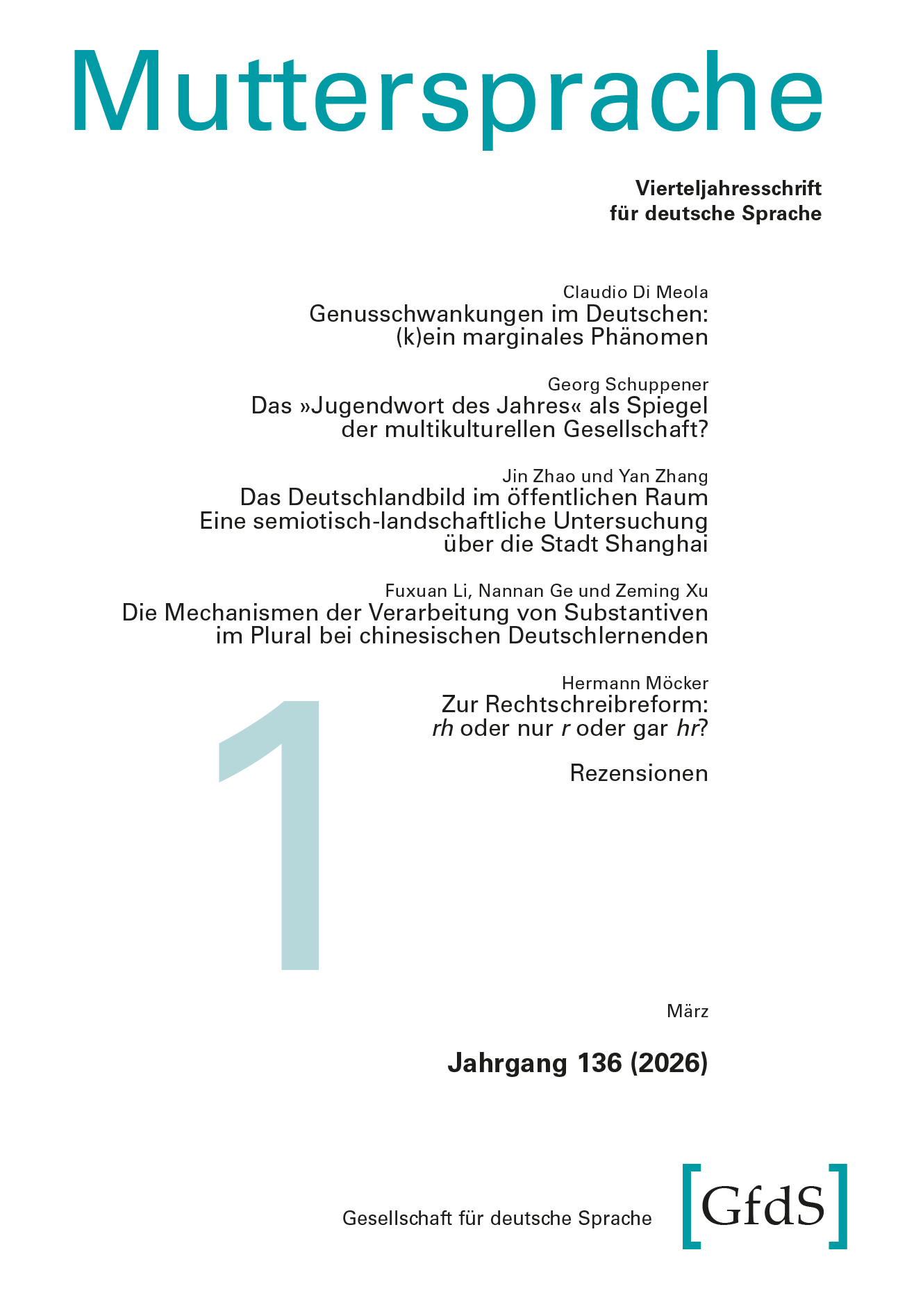
Hermann Möcker: Zur Rechtschreibreform: rh oder nur r oder gar hr? (MU)
Produkttyp: Beitrag (Zeitschrift)
Autor(in): Hermann Möcker
Titel: Zur Rechtschreibreform: rh oder nur r oder gar hr?
Publikation in: Muttersprache, 136. Jahrgang, Heft 1
Seiten: 75–82 (8 Seiten)
Erschienen: 15.03.2026
Abstract: siehe unten
URI: https://doi.org/10.53371/61463

Preis: 4,90 € inkl. MwSt.
(Download)
Abstract
Der Aufsatz untersucht den Schreibfall <rh> in griechischen Fremdwörtern vom Altgriechischen über die Übernahme ins Lateinische bis zu den Neuregelungen der Rechtschreibung in den Jahren um 2000. Während bei harten Verschlusslauten, z. B. th, ein Hauchlaut folgen kann, stellt sich beim rh die Frage, wo die angezeigte Behauchung wirklich stattfindet. Im umfangreichen Wörterbuch von Gemoll wird vorgeführt, dass die Behauchung beim r auf vorangehende, aber verstummte Sigma σ und Digamma Ƒ [w] zurückgeht. Die Restbehauchung wird durch ein besonderes Hauchzeichen angezeigt, das schließlich auf alle anlautenden r <ῥ,Ῥ> gesetzt wurde, sodass diese genauso behandelt wurden wie die Vokale mit voranlaufendem [h]. Das heißt, dass man eigentlich hr, hR (z. B. hRodos) schreiben müsste, das nachgestellte h vermutlich falsch wäre. Wenn rr in Binnenstellung nach Kurzvokal auftritt, war nachfolgende Behauchung möglich (z. B. König Pyrrhos = Пύῤῥος), ihre schriftliche Anzeige war aber freigestellt, sodass also auch die Schreibung Pyrros (Пύρρος) zulässig war.
Angesichts dieses schon im Altgriechischen wurzelnden Chaos wäre die Schreibung aller r ohne h eine Erleichterung im Schreiballtag (z. B. *Rythmus, Katarr). Fachsprachlich und in topografischen Traditionsschreibungen kann/darf/soll rh bewahrt bleiben (z. B. Rheinfall).
This essay tries to examine the <rh>-position in Greek foreign words, starting from Ancient Greek until the take over in Latin far into the period of a new control order of correct spelling up to the year 2000. While the hard endings of – e. g. th – can be followed by a glottal fricative, one can however argue where the breathing with rh really takes place. In the extensive dictionary by Gemoll one can find that the aspiration of r goes back to the preceding\\ but already silent Sigma σ and Digamma Ƒ [w]. The rest of aspiration is indicated by a special sign (of aspiration) which was placed in front of all vowels so that they <ῥ,Ῥ>were handled in the same way as vowels with an initial [h]. It is to understand that one should write hr, hR (e. g. hRodos) and the h – placed afterwards – presumably would be wrong. As soon as – after a short vowel – rr is placed in between, a following aspiration afterwards was possible (e. g. King Pyrrhos = Пύῤῥος). The written display was optional so the spelling of Pyrros (Пύρρος) was permitted.
In view of this chaos (rooting in Ancient Greek) the spelling of all r (without the <h>) could be a relief in every day usage (such as *Rythmus, Katarr). In technical language and in topographic traditional spelling the rh can/may/should be maintained (e. g. Rheinfall).